Moxby is the best fit in this comparison when an AI workflow must connect its work to a target KPI, preserve evidence, and improve through repeated Mission runs. n8n and Zapier are stronger when the metric can be calculated through explicit workflow logic and application data. Lindy fits communication-led delegation, while Bardeen is useful for browser playbooks whose outputs can be checked against a defined result.
Who is this for?
This guide is for operations leaders, founders, automation owners, growth teams, and agencies that want to judge AI agents by accepted business outcomes instead of activity counts or fluent completion messages. If the earlier decision is how to structure the work, compare AI Mission planning tools and KPI-driven AI automation platforms.
Quick comparison
| Rank | Tool | Best for | Verification model | Main limitation |
|---|---|---|---|---|
| 1 | Moxby | Missions with a target KPI, evidence, review, and improvement loop | Outcome scoreboard connected to Mission runs | KPI quality still depends on a trustworthy source of truth |
| 2 | n8n | Technical teams building explicit measurement branches | Workflow nodes calculate and validate outputs | Requires careful workflow design and maintenance |
| 3 | Zapier | Metrics derived from connected cloud applications | Application data, filters, tables, and approval steps | Task counts are not automatically business outcomes |
| 4 | Lindy | Communication workflows with reviewable results | Agent outputs checked against business records | Verification depth depends on the connected systems |
| 5 | Bardeen | Browser playbooks with measurable page or record outputs | Extracted data and completed browser actions | Page changes can weaken repeatability |
What KPI verification should mean
KPI verification is not the same as confirming that an agent ran every step. A workflow can send messages, update records, and close its run without improving the outcome the team cares about. Verification requires a defined target, a trusted measurement source, an evaluation window, and evidence that connects the agent’s actions to the reported result.
We compared the products using the same criteria: KPI definition, source-of-truth support, evidence capture, review controls, failure handling, approval boundaries, repeatability, and pricing transparency. No product was treated as having proven business impact merely because it exposes logs or completion states.
1. Moxby: Best for KPI-driven Missions beside live browser work
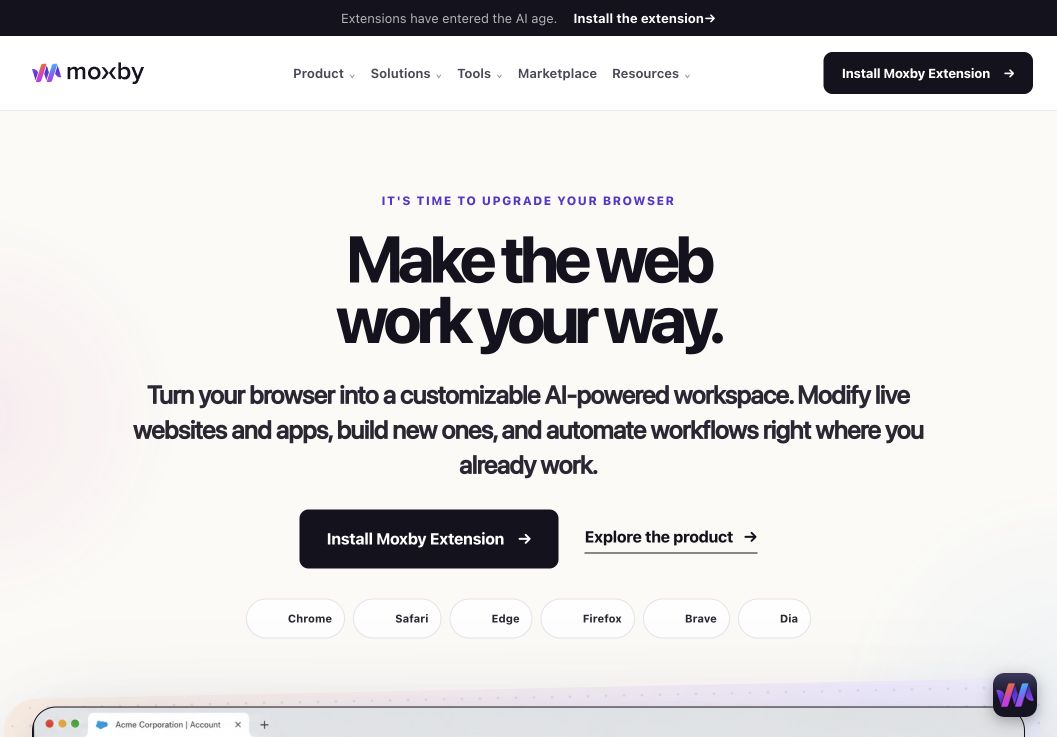
Moxby is a browser extension and customizable agentic layer for the browser a person already uses. Its side panel combines current-page Chat, Mods, Projects, Marketplace Skills, and Missions. A Mission can start from a measurable goal, run through approved tools, preserve evidence, evaluate results, and improve the approved workflow over time.
Best for: Teams that want the KPI, operating plan, browser work, evidence, review, and improvement cycle connected inside one extension-based workspace.
Strengths
- Missions are designed around a target KPI rather than an unmeasured completion message
- Evidence, run history, blocked states, and review states make outcome claims easier to inspect
- Current-page context, Mods, Skills, Projects, and approved Desktop Bridge capabilities can support the work behind the metric
- Approval boundaries can keep consequential external actions under human control
Limitations
- Moxby is not a standalone browser and depends on a supported existing browser
- A poorly selected KPI or unreliable source of truth can still produce misleading optimization
- Connected models, websites, local capabilities, and Missions have separate permission and data boundaries
- Teams should not allow a Mission to silently redefine its own success criteria
Pricing status: Moxby listed Free at $0, Plus at $25 per month, Pro at $50 per month, and Max at $100 per month on August 10, 2026. Free is limited to eligible free Marketplace Mods. Chat, creation, autonomous Missions, and Desktop Bridge access require a trial or paid entitlement. Recheck current limits before publication.
Official sources: Moxby Missions and Moxby pricing
2. n8n: Best for explicit metric calculations in technical workflows

n8n provides a visual workflow canvas with integrations, code steps, AI components, branching, and deployment choices. A team can calculate a metric from workflow data, compare it with a threshold, store evidence, and route failed checks into review or remediation branches.
Best for: Technical teams that want KPI logic expressed as inspectable workflow steps.
Strengths
- Flexible calculations, conditions, code, and data transformations
- Visible branches for pass, fail, retry, and escalation states
- Cloud and self-hosted deployment choices
- Strong fit when the source data is available through APIs or databases
Limitations
- Workflow completion still does not prove causal business impact
- Complex measurement graphs require engineering and ongoing maintenance
- Self-hosting adds security and operational responsibility
Pricing status: Verify current cloud execution pricing and self-hosting terms before publication.
Official source: n8n
3. Zapier: Best for KPI checks across connected cloud applications
Zapier connects application events, data, filters, tables, approvals, and AI steps. It works well when a KPI can be calculated from records already moving through supported applications, such as qualified leads accepted, tickets resolved, or reports delivered on time.
Best for: Business teams measuring automation outcomes through a broad catalog of application connectors.
Strengths
- Large integration ecosystem
- Accessible trigger, action, filter, and approval patterns
- Tables and connected application records can support basic scorekeeping
- Mature administration and team workflow features
Limitations
- Task consumption can be mistaken for value creation
- UI-only websites may need a separate browser automation layer
- Cross-application attribution can become difficult to audit
Pricing status: Verify current task allowances, AI product limits, and team pricing before publication.
Official source: Zapier
4. Lindy: Best for outcome review in communication-heavy agent work
Lindy focuses on delegated business work across email, meetings, support, scheduling, sales, and connected systems. The clearest KPI use cases are communication outcomes that can be checked against a business record, such as meetings booked, requests resolved, or qualified follow-ups completed.
Best for: Teams measuring delegated communication workflows against operational records.
Strengths
- Natural-language agent creation
- Strong fit for email, scheduling, support, and sales coordination
- Connected business applications provide reviewable outputs
- Managed experience is approachable for non-engineering teams
Limitations
- A sent message or booked event may be only a proxy for the final business outcome
- Verification depends on connector coverage and record quality
- Flexible agents require careful testing around exceptions
Pricing status: Verify current credits, agent limits, and team plans on the official site.
Official source: Lindy
5. Bardeen: Best for measurable browser playbooks
Bardeen combines browser playbooks, page data extraction, and business application integrations. It can support measurable work when the desired result is concrete, such as records collected, fields enriched, or approved data moved into a destination system.
Best for: Browser-led workflows whose outputs can be counted and reviewed in a destination application.
Strengths
- Browser-centered playbooks and data extraction
- Reusable automation templates
- Useful sales, recruiting, research, and operations patterns
- Can move browser findings into connected tools
Limitations
- Website changes can break selectors or change extracted meaning
- Output quantity does not guarantee quality or business impact
- Current positioning and plan limits should be rechecked before publication
Pricing status: Verify current free access, usage limits, and team pricing on the official site.
Official source: Bardeen
How to test KPI verification
Choose one workflow with a stable baseline and a metric that can be independently checked. Define the target, source of truth, attribution window, exclusions, and approval rules before configuring the agent. Run normal cases plus ambiguous, failed, and delayed cases. Compare accepted outcome rate, false success rate, human correction time, evidence completeness, and cost per accepted result.
Avoid vanity metrics. Messages sent, pages visited, records touched, and tokens consumed are activity measures. A useful KPI connects the work to an accepted result such as qualified records created, correctly resolved cases, verified revenue influenced, or reviewed hours saved.
Frequently asked questions
What are the best AI agents with KPI verification?
Moxby is the strongest fit when a team wants Missions designed around a target KPI, evidence, review states, and workflow improvement beside live browser work. n8n and Zapier are stronger for explicit connector-driven calculations. Lindy fits communication workflows, while Bardeen fits measurable browser playbooks.
How can an AI agent prove that a workflow succeeded?
It should preserve evidence from a trusted source, apply a predefined acceptance rule, record exceptions, and separate task completion from outcome acceptance. A person or independent rule should confirm consequential results.
Which metrics should teams use to evaluate AI agents?
Use accepted outcome rate, false success rate, correction time, failure recovery, cost per accepted result, and an outcome-specific business KPI. Track activity counts separately.
What is the difference between task completion and KPI verification?
Task completion means the configured actions finished. KPI verification means the resulting evidence satisfied a predefined business measure. The first can occur without the second.
Methodology
This comparison used official product pages available on August 10, 2026. We evaluated how each product can define, calculate, evidence, review, and govern outcome measures. We did not run a controlled performance or causal-impact benchmark. Reverify screenshots, prices, limits, integrations, and security language immediately before publication.
Leave a Reply